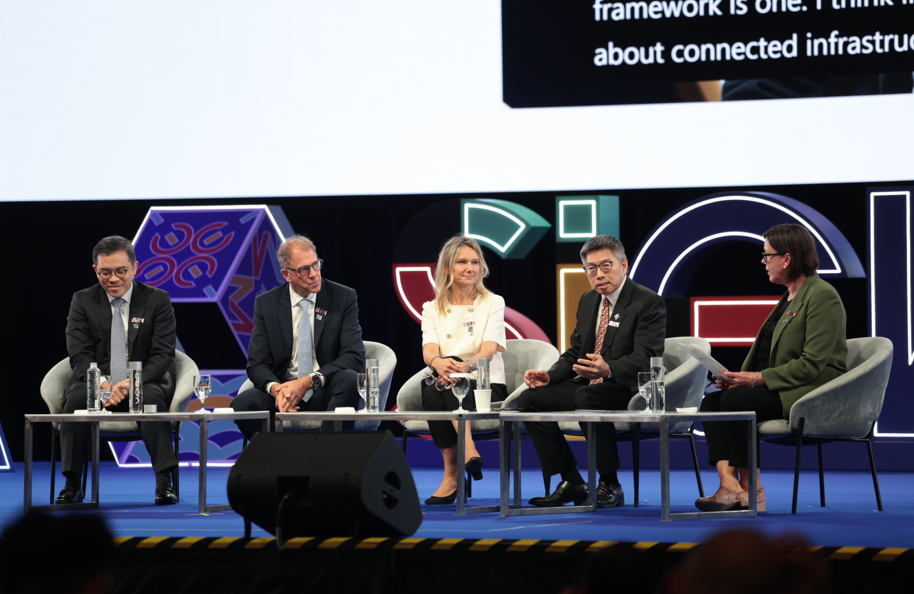
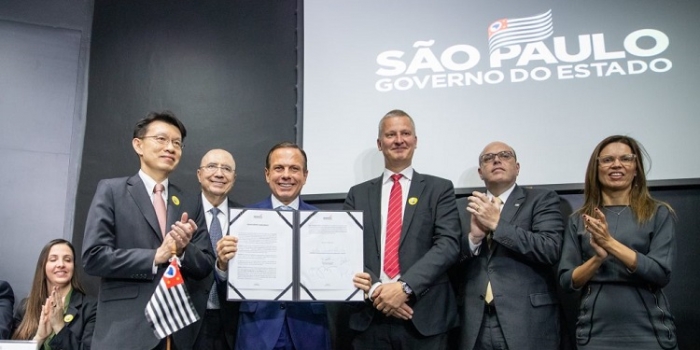
“Connected grids are a key building block to harness the regional strengths of countries in energy for the common good,” said William Goh, Global Head of Renewable Energy at RGE, speaking at the Singapore International Energy Week 2025.
Joined by leaders from RTE International, Prysmian and SGEI, William shared how regional collaboration can move ASEAN from ambition to bankable, interconnected projects, and deliver real benefits to industries and communities across the region.
Collaboration Comes First
William emphasised that public–private partnerships alone aren’t enough. What’s needed is Government–Government–Private (GGP) collaboration that combines regulatory alignment with private sector execution and financing.
“Government-to-government collaboration enables the right regulatory frameworks for renewable energy certificates and electricity-trading recognition. The private sector brings innovation, financing and execution discipline,” said William.
He emphasised that collaboration is what converts ambition into reality. “Without it, even the best engineering designs or financing structures remain pilots rather than pipelines,” he noted.
Policy Certainty Unlocks Capital
To unlock long-term capital for cross-border energy infrastructure, policy certainty must come first. William highlighted the “three Cs” of effective energy policy:
- Clarity in licensing and carbon accounting
- Consistency across jurisdictions and over the long term
- Constructiveness in enabling innovation
This will provide long-term certainty which will give investors the confidence to fund projects that often span decades. Such stability, he said, is what transforms short-term initiatives into durable infrastructure and ensures investors stay engaged through shifting market conditions.
Engineer for Resilience and Cost
From a transmission-system operator’s lens, RTE International’s Veronika Milewski said interconnections raise stability and efficiency by smoothing variability and strengthening supply security. She underlined three enablers for a connected market: coordination and data exchange to share a common view of grid risks; a common operational playbook across TSOs; and investment in hardware – not only the interconnectors but the national grids that feed them. Prysmian’s Detlev Waimann added that multi-decade cable systems must be designed for high availability, with reliability embedded from design to maintenance.
William echoed that view from RGE’s project experience: “We spend a lot of effort making sure the technical solution, from photovoltaic cells to battery energy storage and transmission grid redundancy, ensures stability and load matching. But it is equally important to optimise. Building redundancy is good, but it must make economic sense,” said William.
For RGE, he added, that balance between reliability and cost efficiency defines the company’s approach to every renewable project, designing systems that are both strong and smart.
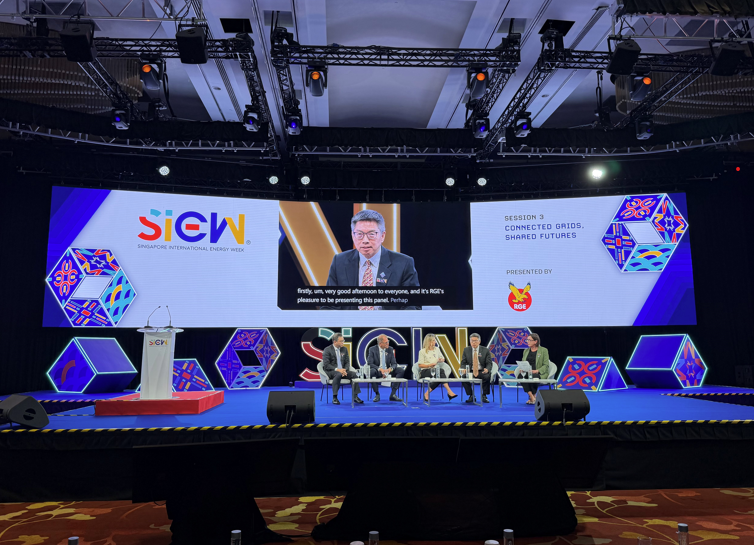
At the 2025 Singapore International Energy Week, RGE Global Head of Renewable Energy William Goh joins a panel of industry leaders in a discussion on building renewable energy projects across borders in ASEAN.
From Vision to Projects
William also shared how RGE is moving regional energy integration from concept to reality. The company is partnering with TotalEnergies and the governments of Indonesia and Singapore on renewable energy projects aligned to the ASEAN Power Grid vision, integrating generation, transmission and storage across borders. This allows clean energy to move to where it is needed most, when it is needed most.
He noted that implementation requires more than permits and power purchase agreements. It also depends on practical enablers across the logistics chain. SGEI CEO Ong Teng Koon shared this view, noting that Southeast Asia currently lacks the specialised vessels, equipment and spares that Europe uses for subsea cable deployment. SGEI is now working to build this capability, developing warehousing for critical spares and harmonising technical standards for interconnectors into Singapore.
Building on that point, William underlined the two-level collaboration required for success. Government to government partnerships create the enabling frameworks, while government with private partnerships deliver execution. He shared how RGE is working with partners and stakeholders to move projects from concept to construction.
He added that such projects only succeed when customers are ready to contract for renewable electricity at scale. That customer commitment, together with bankable structures and aligned public policy, is what turns regional vision into operational reality.
Collaboration as the game changer
To close the session, William summarised the four essentials for cross-border energy projects:
- Technical reliability with optimisation
- Clear, consistent policy frameworks
- Customer commitment to renewable offtake
- Financial viability through shared risk
All of these, he noted, depend on trust and strategic alignment. “Timelines must align. Information must be shared. That’s how we compress development cycles and reduce cost of capital,” he concludes. “Without strategic collaboration, nothing can be changed. ASEAN’s energy future must be shaped by cooperation. With sound engineering, enabling policy and committed partners, connected grids can deliver reliable, clean and competitively priced power. This will support growth and will improve the quality of life for the good of everyone across the region.”